Dubai Reefs Mega-Project Shows Promising Early Environmental Results
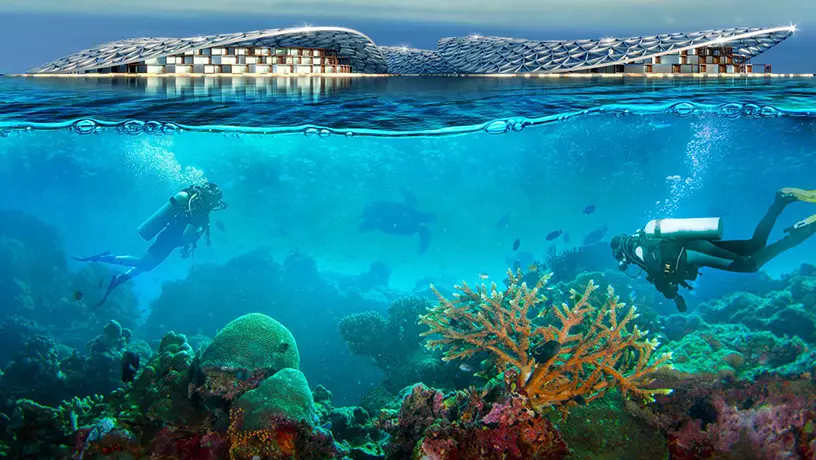
Dubai’s ambitious initiative to create one of the world’s largest artificial reef systems is already demonstrating significant environmental benefits, with recently released footage revealing schools of local fish thriving around the concrete structures. The Dubai Reefs project, launched in November 2021, represents a major effort to restore marine life in coastal waters where the naturally soft seabed provides limited habitat for marine organisms.
According to monitoring data, fish biomass around the artificial reefs has increased eightfold compared to baseline measurements taken in 2021, while biodiversity has grown by 10%. The structures have attracted various native species including groupers, snappers, and barracudas, creating vibrant new ecosystems.
Omar Al Nuaimi, Director of Dubai Reefs at the Department of Economy and Tourism, emphasized that the project aims not to replace nature but to provide it with a foundation. The specially designed low-carbon concrete modules gradually transform underwater, providing surfaces for microorganisms and invertebrates to attach while offering shelter for juvenile fish.
The proof-of-concept phase, conducted over three years, has convinced authorities of the approach’s effectiveness. So far, 3,600 modules have been deployed—representing 39% of the planned total—with an additional 20,000 scheduled for installation by the end of 2027. The project features six modular designs that mimic natural reef structures, ranging from the 1.7-meter “Reef Shade” to the six-meter tall, eight-meter wide “Ocean Castle” designed for deeper waters. The largest installations will be placed at depths exceeding 25 meters, carefully positioned to maintain safe shipping channels.
Deployment presents substantial logistical challenges. Modules are stacked on barges in groups of up to 160—a process taking half a day—before cranes carefully lower them into precise positions, often in groupings designed to create complex habitats. Weather conditions significantly impact the installation schedule, with calm seas accelerating progress and rough weather halting operations.
The project rests on three foundational pillars: habitat restoration, marine life rehabilitation, and scientific research. Dubai aims to establish itself as a regional hub for marine science, with ongoing studies focused on coral restoration and long-term ecological monitoring. The initiative brings together biologists, engineers, port authorities, and customs officials to ensure proper reef design and placement away from navigation routes and anchoring zones, representing a comprehensive approach to marine ecosystem recovery.
Source: The National