
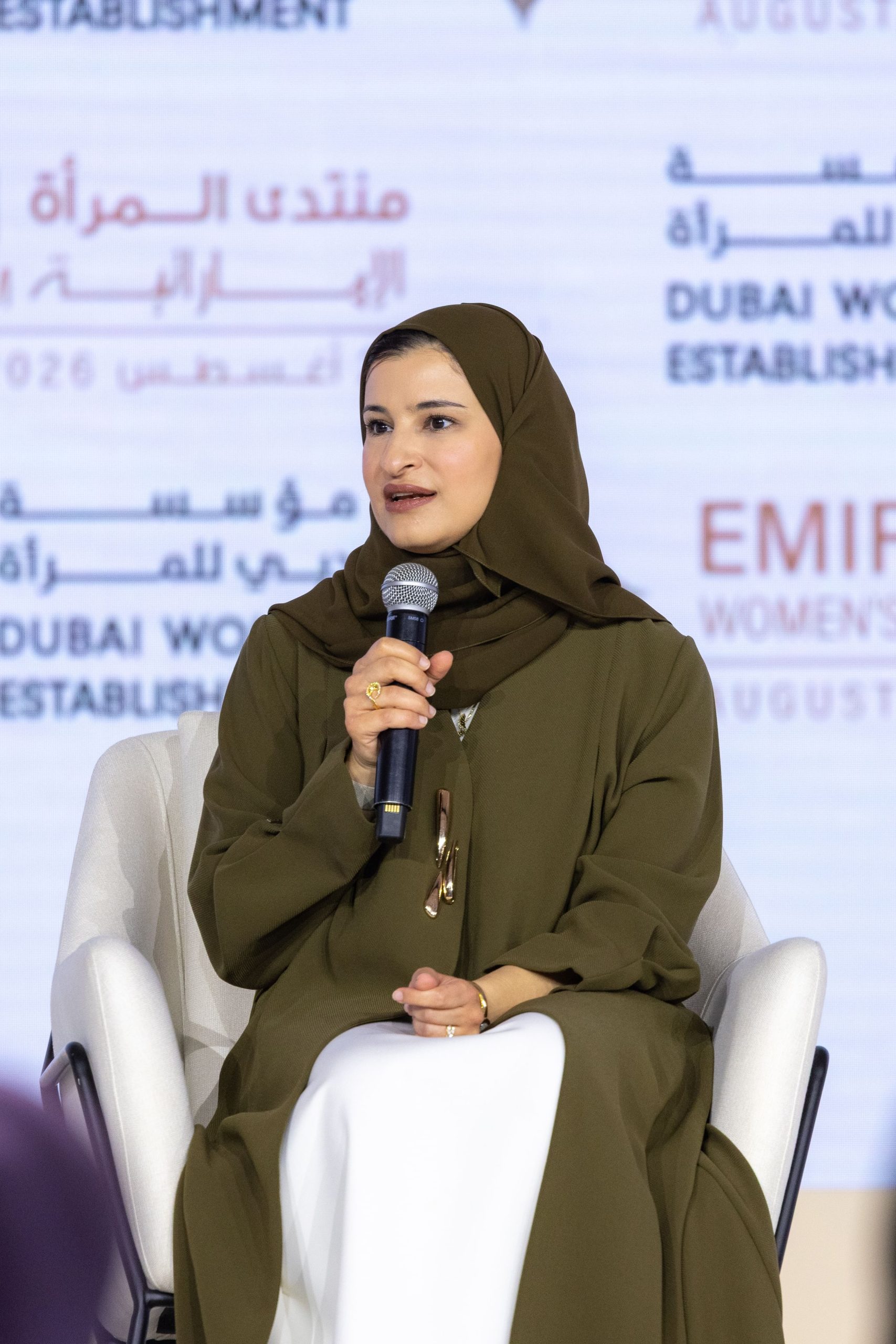
Sarah Al Amiri highlights Emirati women’s role in shaping the UAE’s future
Sarah Al Amiri, UAE Minister of Education, has highlighted the central role Emirati women play in preparing future generations and supporting the country’s long-term development.
Speaking at the Emirati Women’s Forum 2026 at Madinat Jumeirah in Dubai, Al Amiri focused on education, national identity, technology and the importance of investing in people.
The forum was held as part of the UAE’s celebrations for Emirati Women’s Day, which this year carries the theme “We Emerge Stronger and Better.”
Investing in people comes first
During a session titled “Women Shaping Generations and Building the Future,” Al Amiri said human development remains one of the foundations of the UAE’s future.
For the country to continue progressing, she said younger generations need more than academic knowledge.
They must also develop strong values, practical skills, confidence and the ability to adapt to rapid change.
Education therefore has a much broader role than simply preparing students for examinations or specific careers.
It is also responsible for developing people who can respond to new challenges and contribute responsibly to society.
Women help shape the next generation
Al Amiri emphasised that Emirati women play several interconnected roles as mothers, educators and leaders.
Their influence extends beyond their own professional achievements because they also help shape the attitudes, ambitions and values of younger generations.
This responsibility is becoming increasingly important as technology, employment and the skills required in the workplace continue to evolve.
Young people, she said, need to remain confident in their identity while also being comfortable with science, innovation and new technologies.
Families and schools must work together
Another important part of Al Amiri’s message focused on the relationship between families and educational institutions.
Schools cannot build the next generation independently.
Strong cooperation between parents and educators is needed to reinforce national identity, values and the Arabic language, while simultaneously preparing students for a highly international and technology-driven future.
The challenge is to create young people who can operate confidently in a changing world without losing their connection to their culture and identity.
National Education Charter supports UAE identity
Al Amiri also highlighted the importance of the National Education Charter.
The charter is designed to strengthen national identity while defining the qualities and values students need to become active members of society.
For the UAE, education is therefore closely connected to the wider national vision.
Developing future-ready talent is not only about creating skilled employees. It also involves preparing responsible citizens capable of contributing to their communities and the country.
AI should support thinking, not replace it
Artificial intelligence was another major theme of the discussion.
As AI becomes increasingly integrated into classrooms and everyday life, Al Amiri stressed that technology should be used to strengthen learning and critical thinking rather than simply provide ready-made answers.
Students should not automatically accept everything generated by an AI system.
Instead, they should learn to question information, verify results and make informed decisions themselves.
That approach is increasingly important as AI tools become more powerful and accessible.
The objective is not to keep technology away from students, but to teach them how to use it responsibly.
Preparing students for a changing world
The rapid evolution of technology is also changing the skills young people will need throughout their careers.
Traditional knowledge alone may no longer be enough.
Adaptability, critical thinking and the ability to learn continuously are becoming increasingly important as industries transform and entirely new professions emerge.
Al Amiri argued that education must respond to these changes while continuing to provide students with a strong personal and cultural foundation.
This balance between innovation and identity is becoming one of the UAE education system’s most important priorities.
Encouraging Emirati girls to aim higher
Al Amiri also addressed young Emirati women directly, encouraging them to pursue opportunities with confidence and ambition.
She urged girls to continue building their knowledge and experience while focusing on creating meaningful impact rather than simply achieving individual success.
Her message reflects the broader transformation of women’s participation across the UAE.
Emirati women now hold influential positions across government, education, science, technology, business and many other sectors.
Their role, Al Amiri said, is not separate from the country’s development — women are full partners in shaping it.
Building the UAE’s future through education
The discussion at the Emirati Women’s Forum ultimately connected three areas that are becoming increasingly important to the UAE: women’s empowerment, education and human capital.
For Al Amiri, the country’s future will depend heavily on the quality of the generations being prepared today.
That means developing young people who understand their identity, think independently, use technology responsibly and have the confidence to adapt to a changing world.
And Emirati women, whether as leaders, teachers or mothers, will continue to play a major role in making that future possible.