


UAE Capital to Welcome World’s First Net-Zero Carbon Mosque
The capital of the United Arab Emirates is set to inaugurate a landmark project this October: the world’s first mosque built to fully comply with a net-zero carbon emissions principle. This pioneering initiative was realized by Masdar City in collaboration with the British architectural firm Arup.
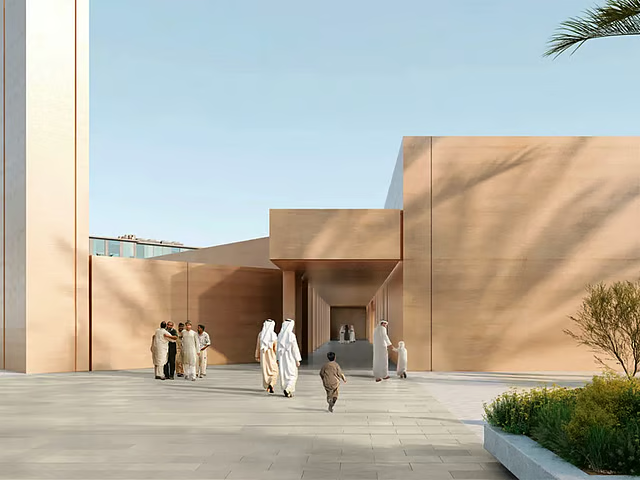
The mosque is designed to be entirely self-sufficient in its energy needs, generating 100% of its required power through on-site solar panels. The design seamlessly blends innovative construction techniques with advanced environmental solutions. With a capacity for 1,300 worshippers, the building’s architecture draws inspiration from the UAE’s rich heritage, specifically the 15th-century Al Bidya Mosque. In a modern tribute to this ancient construction method, the architects utilized rammed earth sourced from a local quarry.
A key focus of the design has been adapting to the region’s harsh climate. Specific features include a double-fortified western wall, strategically placed canopies, slanted windows, light wells, high-performance thermal insulation, and reflective materials to mitigate heat gain.
Furthermore, smart technology will be integral to the mosque’s operations. An automated system will intelligently regulate ventilation and air conditioning based on real-time factors like occupancy, temperature, and humidity. This sophisticated approach is projected to reduce energy consumption by a third and slash water usage by more than half.
Representatives from Masdar City have hailed the project as a “first of its kind” in the Middle East. Engineer Amna Al Zaabi emphasized the project’s significance, noting that a structure of this scale using the rammed earth method had never before been constructed in the Emirates, marking a new chapter in sustainable and culturally resonant architecture.
Source: Gulf News