Dubai teenager creates low-cost hydration tablets for outdoor workers
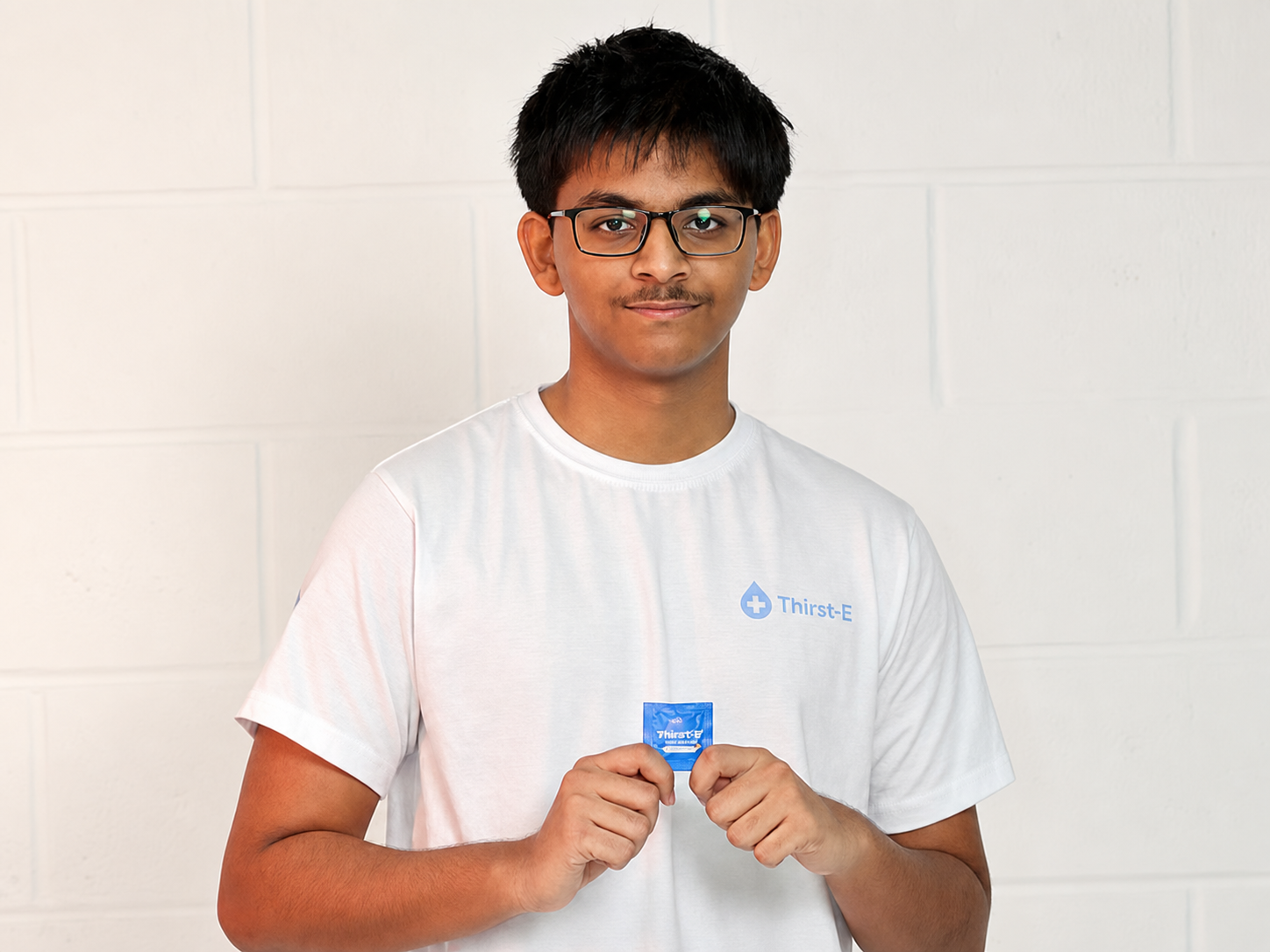
A 16-year-old student in Dubai has developed an affordable hydration tablet designed to support delivery riders and other people working outdoors in extreme heat.
Jash Jain, a student at Dubai International Academy, created the product after an encounter with a visibly exhausted delivery rider made him question whether access to water alone was always enough during long hours outside.
That moment eventually led to Thirst-E, a dissolvable hydration tablet that Jain hopes can offer workers a portable and low-cost way to replenish essential nutrients during the UAE’s hottest months.
One delivery rider inspired the idea
The project began when a delivery rider named Ali arrived at Jain’s home with groceries.
The rider looked exhausted, so Jain invited him to sit down and offered him food and water.
Ali explained that he had already consumed two bottles of water but still felt severely dehydrated.
The conversation stayed with Jain.
He began researching hydration in extreme temperatures and looking at products already available on the market.
Sports drinks could be too expensive for workers to consume regularly, while some hydration tablets sold through pharmacies were not always practical or accessible for people spending most of their working day on the road.
He spoke directly with 50 delivery riders
Rather than developing the idea entirely on his own, Jain began speaking with the people he wanted the product to help.
He interviewed 50 delivery riders, asking about the physical demands of their work, the hydration challenges they experience and what support they receive from employers.
Their feedback helped shape the concept behind Thirst-E.
The aim was to create something inexpensive, portable and easy to use during a working day.
Each tablet dissolves in water and contains 274mg of sodium, 20mg of magnesium, 40mg of Vitamin C and 10mg of zinc.
Turning a school-age idea into a certified product
Developing the product required much more than deciding on ingredients.
Jain researched the formulation, consulted a doctor in his family and sought advice from someone with experience in the hydration supplement industry.
The final formulation was manufactured by an Indian white-label producer that already makes similar products for pharmacies.
Along the way, Jain also had to consider questions he had not initially expected.
When a teacher asked whether the product was suitable for pregnant women, for example, he contacted the manufacturer to clarify its suitability.
Thirst-E receives approval for sale in Dubai
Before the product could be introduced commercially, it had to go through testing and certification.
The formulation was tested in India and received a free-sale certificate from the Indian government.
Bringing Thirst-E to Dubai involved further legal and regulatory work before the product eventually received the required Dubai Municipality certificate permitting its sale.
For a project founded by a teenager, navigating that process became an education in product development, regulation and entrepreneurship in its own right.
Delivery and warehouse workers test the tablets
One of Thirst-E’s first substantial pilot programmes involved more than 60 employees working in 6thStreet’s delivery and warehouse operations.
Fifteen participants later completed detailed feedback surveys.
Among them, 100 per cent said the tablet was easy to use, while 93 per cent liked the taste and 93 per cent reported feeling more hydrated after taking it.
The pilot also highlighted the scale of the problem Jain was trying to address, with 67 per cent of respondents indicating significant levels of daily dehydration.
A teenager running a growing project
Jain currently oversees much of the operation himself.
His responsibilities include product development, discussions with companies, pilot programmes, partnerships and collecting feedback from users.
A five-person team supports the project through social media and digital content.
The project is now looking beyond small-scale trials towards partnerships with larger companies employing significant numbers of outdoor workers.
Tablets could cost just 50 fils
Jain plans to approach delivery and construction companies through a business-to-business model.
Under the proposal, individual sachets could be supplied for around 50 fils each, keeping the cost low enough for large-scale distribution.
He has also held discussions with Talabat about a potential pilot involving delivery riders, although no partnership has yet been confirmed.
Another idea is to introduce a “hydrate your rider” option inside delivery apps.
Customers could add 50 fils to their order, with the contribution helping provide hydration tablets to the rider delivering their food or groceries.
Consumers could also buy the tablets themselves and offer them to delivery riders, gardeners and other people working outdoors.
A small product addressing a very visible Dubai challenge
Extreme summer temperatures are part of everyday life in Dubai, but their impact is felt particularly strongly by people whose jobs require them to remain outside for long periods.
Jain’s project does not attempt to solve that challenge through a complicated or expensive technology.
Instead, it focuses on something deliberately simple: a portable hydration tablet at a price designed to make large-scale distribution realistic.
What began with one exhausted rider arriving at a teenager’s front door has now become a certified product, a pilot programme and a potential business.
More importantly, it has turned Jain’s attention towards a group of workers who remain essential to the daily rhythm of Dubai — especially during the months when simply being outdoors can become physically demanding.