


UAE launches first locally built commercial satellite into orbit
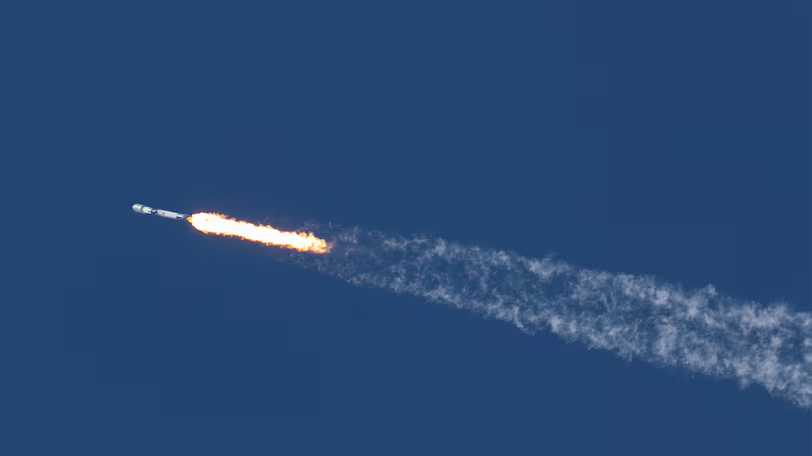
The UAE has reached a new milestone in its space ambitions with the successful launch of Altair-1, the first commercial satellite designed, assembled and tested entirely in the country.
Built in Abu Dhabi by space technology company Orbitworks, the satellite launched from Vandenberg Space Force Base in California aboard SpaceX’s Transporter-18 rideshare mission.
Altair-1 has already established contact with Earth and begun operations, marking an important step in the UAE’s transition from purchasing space technology to developing and manufacturing it locally.
Built entirely in Abu Dhabi
Altair-1 was developed at Orbitworks’ satellite production facility in Kezad, Abu Dhabi.
Orbitworks was created through a partnership between Abu Dhabi-based Marlan Space and San Francisco company Loft Orbital, combining local investment and manufacturing capabilities with international space technology expertise.
The company’s 4,645-square-metre Abu Dhabi complex is the first facility in the Middle East dedicated to commercial satellite production.
Once operating at full capacity, the factory is designed to manufacture as many as 50 satellites per year — approximately one every week.
The launch of Altair-1 is the first major demonstration of that capability.
First of 10 AI-powered satellites
Altair-1 will not operate alone.
It is the first spacecraft in a planned constellation of 10 AI-powered satellites designed to create an advanced Earth observation network.
The remaining nine satellites are expected to launch in 2027.
Once the constellation is complete, Orbitworks says it will be capable of revisiting almost any location on Earth approximately every four hours.
That speed could allow governments and businesses to receive updated information far more frequently than through conventional satellite systems.
Five sensors on every satellite
Each Altair satellite carries five different sensing technologies: optical, short-wave infrared, thermal, hyperspectral and radio-frequency sensors.
Combining these systems allows the satellites to collect different forms of information about conditions on Earth.
Potential applications include disaster response, maritime monitoring, environmental observation, food security, infrastructure surveillance and national security.
The satellites are also designed to process information autonomously in orbit rather than simply sending raw data back to Earth.
That means the system could identify important events more quickly.
For example, the technology could potentially detect a wildfire during its early stages or identify suspicious vessels operating at sea.
AI brings intelligence into orbit
The Altair constellation reflects a broader change taking place across the satellite industry.
Instead of relying entirely on ground-based teams to analyse images and information after they have been transmitted, newer spacecraft can increasingly process data while still in orbit.
Orbitworks describes this as a move towards satellites that can help customers “see, decide and act” much faster.
The combination of artificial intelligence and multiple sensors could make Earth observation more useful in situations where minutes or hours matter, particularly during natural disasters or security incidents.
A major step for the UAE space industry
The UAE has spent years developing a domestic space sector through missions, research programmes and investment in engineering and science.
Altair-1 adds a new commercial dimension.
Rather than focusing only on government-led missions, the project demonstrates that satellites manufactured in the Emirates can also be developed for international customers and commercial applications.
Orbitworks chief executive Dr Hamdullah Mohib described the launch as proof of how rapidly the company has developed, noting that Orbitworks existed only as an idea two years ago.
Today, a satellite manufactured at its Abu Dhabi facility is already operating in orbit.
UAE targets global space leadership
The launch also supports the UAE’s wider National Space Strategy 2031, which aims to strengthen local research, manufacturing and investment while developing new commercial opportunities.
One of the country’s ambitions is to become one of the world’s 10 leading space economies by 2031.
Building satellites domestically is an important part of that strategy because it creates engineering expertise, manufacturing capacity and intellectual property inside the Emirates.
It also gives UAE companies an opportunity to compete for international satellite contracts rather than relying solely on foreign suppliers.
More satellites are already planned
Altair-1 is only the beginning of Orbitworks’ expansion.
The company plans to deploy the rest of the 10-satellite Altair constellation over the next year, while its Abu Dhabi manufacturing facility is expected to produce dozens of additional spacecraft in the coming years.
Loft Orbital chief executive Pierre-Damien Vaujour said the launch demonstrated how far the UAE’s space ecosystem has progressed and highlighted the country’s potential to become an international centre for AI-powered satellite production.
For the UAE, Altair-1 represents more than another successful launch.
It is the first commercial satellite built entirely at home — and a sign that Abu Dhabi is moving from participating in the global space industry to manufacturing technology for it.