


UAE strengthens technology partnership with United States
The UAE is expanding its technology partnership with the United States, with a senior Emirati delegation holding meetings in Washington focused on artificial intelligence, cybersecurity, space, quantum computing and other advanced technologies.
The delegation was led by Omran Sharaf, Assistant Foreign Minister for Advanced Science and Technology, as the two countries explore deeper cooperation between government institutions, research centres and private technology companies.
UAE technology leaders visit Washington
Sharaf was joined by Dr Mohamed Al Kuwaiti, Head of the UAE Government Cybersecurity Council, and Dr Mohamed Alkhemairi, Executive Director of the Research and Development Ecosystem at the Advanced Technology Research Council.
Representatives from the UAE Space Agency and Space42 also participated in the visit.
The delegation met senior US government officials as well as representatives from research institutions, think tanks and technology companies.
The goal was to identify new areas where the UAE and US can collaborate as emerging technologies become increasingly important to economic growth, national security and international competitiveness.
AI, cybersecurity and quantum computing take centre stage
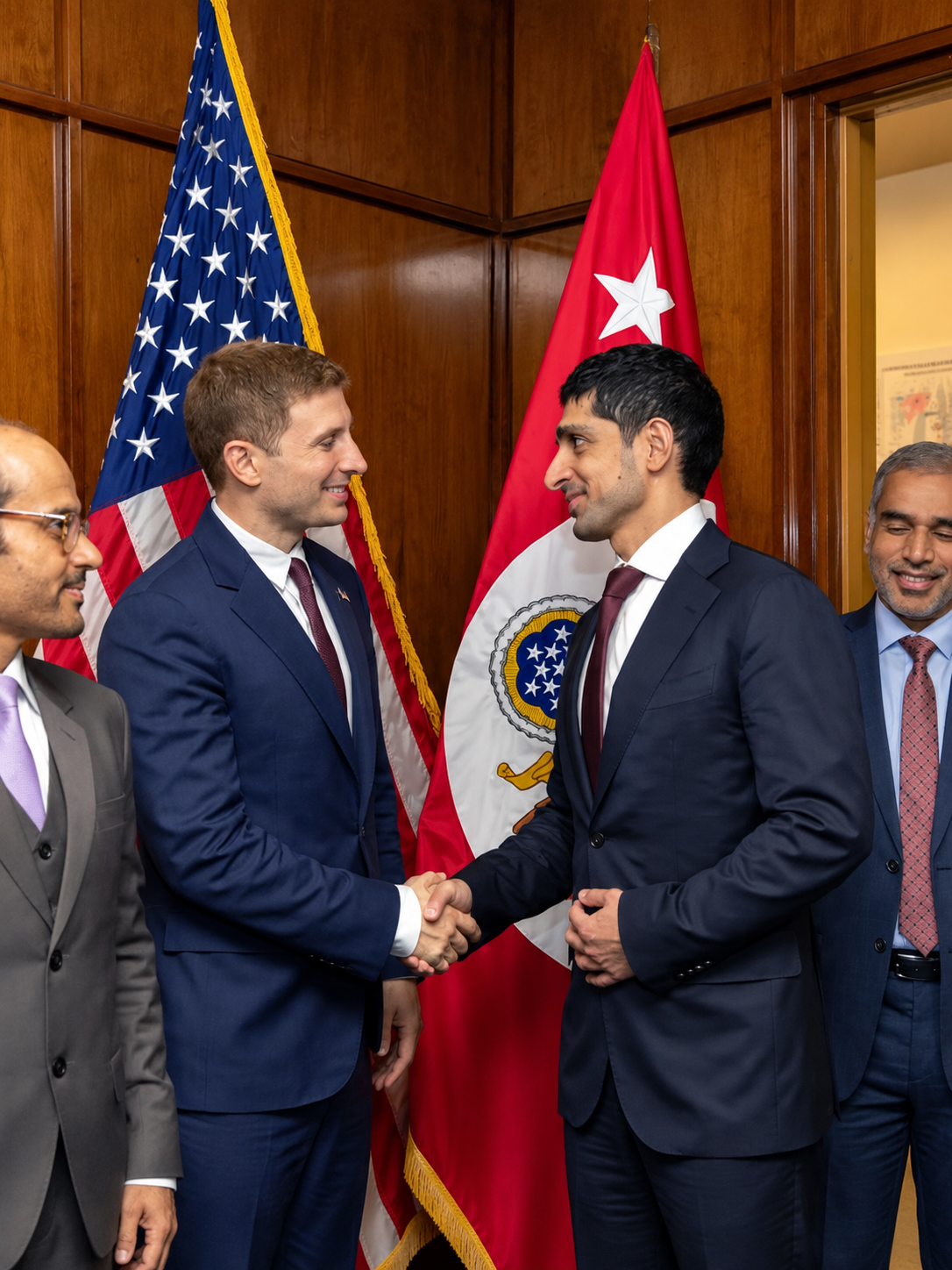
During the visit, Sharaf met Michael Kratsios, Director of the White House Office of Science and Technology Policy, to discuss the future of technological cooperation between the two countries.
Talks focused on areas including advanced artificial intelligence, cybersecurity, quantum technologies, secure digital infrastructure and information sharing.
Future preparedness was another major theme, particularly the development of technologies capable of remaining secure as quantum computing advances.
That includes post-quantum cryptography, which is designed to protect digital systems from potential future threats created by increasingly powerful quantum computers.
Cooperation with the US government expands
Sharaf also held meetings with Jacob Helberg, US Undersecretary of State for Economic Growth, Energy and the Environment, and Adam Cassady, Ambassador-at-Large for Cyberspace and Digital Policy.
Discussions with the US Department of Commerce focused on strengthening trade and technology cooperation, simplifying trade processes and managing exports of advanced technologies.
The talks also covered the recent US decision to move the UAE into Country Group A:5 under the US Export Administration Regulations.
The classification forms part of the broader technology and trade relationship between the two countries and could support closer cooperation in strategically important industries.
Space and private technology companies join discussions
The delegation’s programme extended beyond government meetings.
UAE representatives met organisations including the Hudson Institute, Center for Strategic and International Studies, US-UAE Business Council and Software & Information Industry Association.
The group also met IonQ, one of the companies developing commercial quantum computing technology.
The discussions explored how universities, research institutions and private companies could work more closely together on advanced technologies.
For the UAE, partnerships of this kind form part of a wider strategy to build domestic expertise while maintaining strong links with some of the world’s leading technology ecosystems.
Technology is reshaping global influence
During the Washington visit, Sharaf also participated in a discussion at Johns Hopkins University titled Technology, Power and the New Global Order.
The conversation examined how artificial intelligence, cybersecurity, space technology, critical minerals and other strategic technologies are increasingly influencing international relations and the global economy.
Sharaf highlighted the UAE’s ambition to remain an open, responsible and trusted technology partner, while continuing to invest in scientific research and advanced industries.
UAE pushes deeper into advanced technology
The Washington meetings reflect the UAE’s broader effort to expand beyond traditional economic sectors and strengthen its position in industries expected to shape the coming decades.
Artificial intelligence, space, cybersecurity and quantum computing have all become increasingly important areas of investment across the Emirates.
The UAE now wants those ambitions to be supported by stronger international partnerships connecting governments, universities, research centres and technology companies.
For Sharaf, the priority is turning those relationships into practical projects rather than limiting cooperation to policy discussions.
The latest visit to Washington therefore represents another step in a technology relationship that is becoming an increasingly important part of the wider UAE-US partnership.