



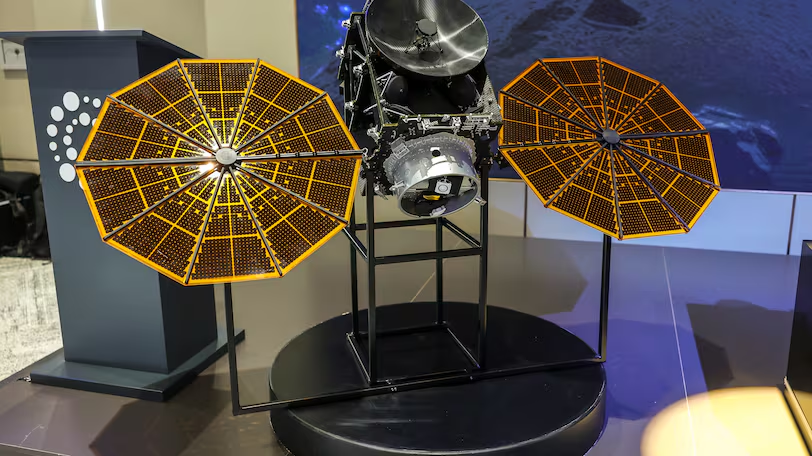
UAE’s MBR Explorer enters final testing ahead of 2028 asteroid mission
The UAE’s MBR Explorer mission has entered a crucial new phase, with its locally developed asteroid probe completing vibration testing and moving into final thermal trials ahead of a planned launch in March 2028.
The mission will send the spacecraft on an approximately five-billion-kilometre journey through the Solar System, passing six asteroids before reaching its final destination, 269 Justitia, in 2036.
The project represents one of the UAE’s most ambitious space missions to date and a major step towards building advanced deep-space technology inside the country.
Final tests are now under way
The deployable probe carried by MBR Explorer has already completed vibration testing, which recreates the intense forces a spacecraft experiences during launch.
It is now undergoing thermal-vacuum testing at a university facility in Al Ain, where engineers are exposing its systems to the extreme temperatures and near-vacuum conditions expected in space.
Once these tests are complete, the probe will undergo further performance checks and a final flight-readiness review before being sent to Colorado for integration with the MBR Explorer spacecraft.
The mission is working towards a narrow three-week launch window in March 2028.
Built largely by UAE engineers
The probe has been designed, built and tested in Abu Dhabi by the Technology Innovation Institute’s Propulsion and Space Research Center, working with the UAE Space Agency and other national partners.
Around 80 per cent of its development has been carried out by UAE engineers, highlighting the country’s growing technical capabilities in deep-space exploration.
Approximately 40 people worked on the probe over an 18-month period, while a wider group of Emirati engineers is gaining experience across the full interplanetary mission.
The programme also includes partners such as Khalifa University, HEX20 and the National Space Science and Technology Centre at UAE University.
For the UAE, the objective extends beyond completing a single mission. The knowledge developed through MBR Explorer is intended to support increasingly independent space projects in the future.
An eight-year journey through the Solar System
MBR Explorer is expected to spend around eight years travelling through space after launch.
To reach the asteroid belt, the spacecraft will use gravity-assist manoeuvres around Venus, Earth and Mars, allowing the planets’ gravity to help alter its speed and trajectory.
Along the way, it will conduct close fly-bys of six asteroids before eventually reaching 269 Justitia.
The spacecraft is expected to spend several months studying Justitia before releasing the UAE-built probe for the mission’s final and most dramatic stage.
The probe will descend without engines
Unlike a traditional lander, the deployable probe will not use a propulsion system to slow itself during its final descent.
After separating from MBR Explorer, it will travel towards the asteroid on a ballistic trajectory, with the descent expected to last between two and three hours.
It could hit the surface at speeds of between 15 and 27 metres per second.
Two cameras will take images throughout the descent, while onboard processing systems will determine which images are most valuable and prioritise them for transmission.
If the probe continues operating after impact, its battery and communications systems could remain active for around 20 to 50 minutes.
The impact itself may also expose material beneath the asteroid’s surface, giving scientists an opportunity to study layers that cannot be observed from orbit.
A spacecraft designed to think for itself
One of the most advanced elements of the probe is its ability to operate independently.
Because of the enormous distance from Earth, it cannot rely on immediate instructions from mission controllers.
Its onboard computer will therefore manage key functions such as imaging, image selection and power use autonomously.
Artificial intelligence may also be used to help analyse and prioritise images, although engineers are keeping critical operations dependent on predictable and carefully controlled systems.
This level of autonomy is particularly important for deep-space missions, where communication delays make real-time intervention impossible.
Why 269 Justitia matters
Justitia has attracted scientific interest because it appears unusual compared with many other objects in the main asteroid belt.
Its colour and spectrum resemble objects found much farther from the Sun in the Kuiper Belt, beyond Neptune.
Scientists believe it may have formed in the colder outer regions of the Solar System before moving inward billions of years ago.
Studying its composition could therefore reveal new information about how water, volatile materials and organic compounds were distributed during the early formation of the planets.
The wider MBR Explorer mission will also help scientists better understand the origins and evolution of water-rich asteroids and their potential importance for future space exploration.
A wider goal for the UAE space sector
The Emirates Mission to the Asteroid Belt is the UAE’s second interplanetary mission and forms part of a broader effort to develop domestic space engineering, science and commercial capabilities.
The project brings together the UAE Space Agency, Technology Innovation Institute, universities, research centres and private-sector partners.
Beyond scientific discovery, one of its main objectives is to ensure that more of the knowledge required for complex missions remains inside the country.
The successful development of the probe already demonstrates how far the UAE’s space programme has progressed.
If the 2028 launch proceeds as planned, MBR Explorer will begin one of the most ambitious journeys ever attempted by the Emirates — travelling billions of kilometres before reaching an asteroid that could hold clues to the earliest history of the Solar System.